
July 15, 2026
Do Colleges Care About Volunteer Hours? What Admissions Officers Actually Say
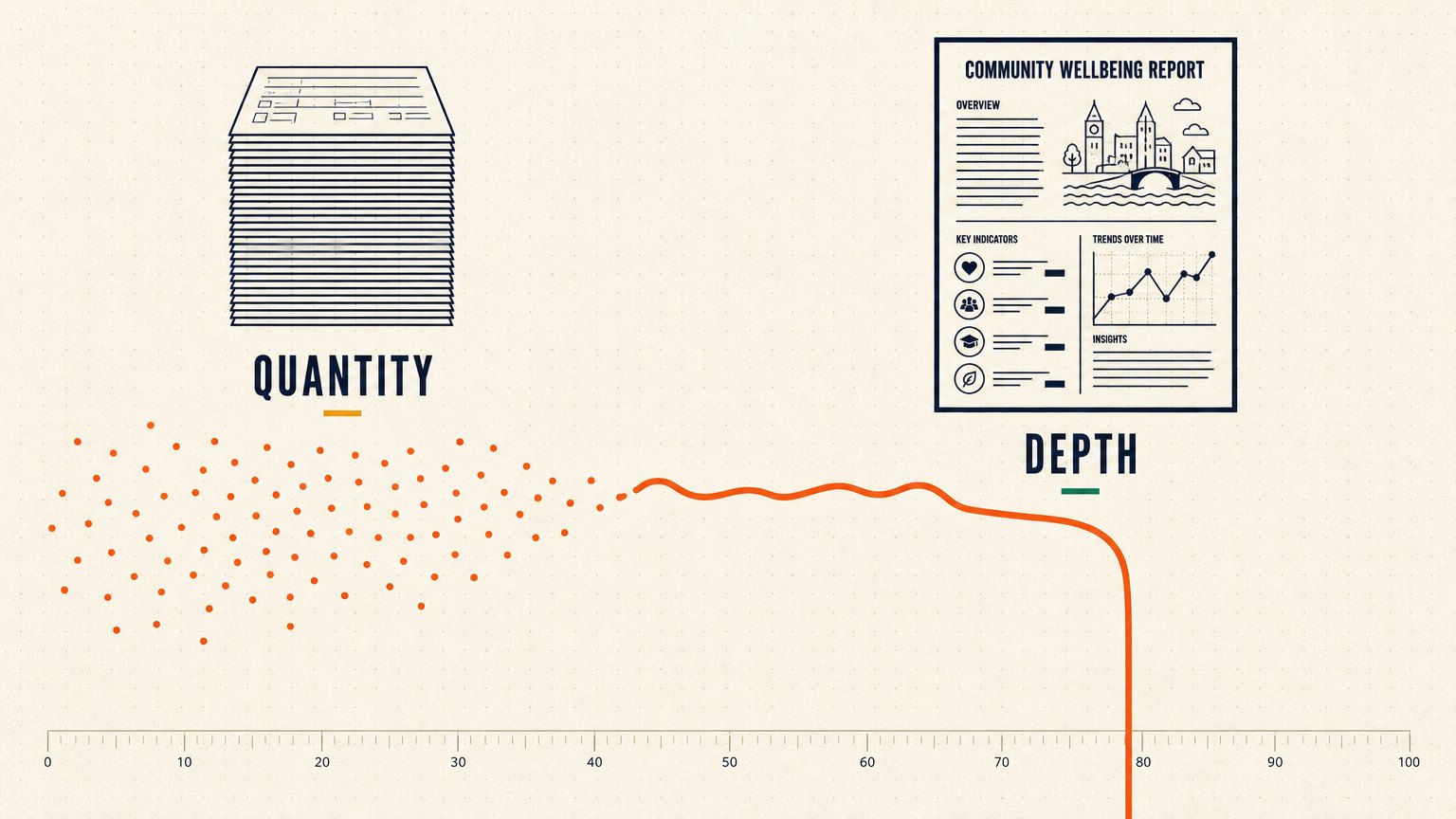
I built a spreadsheet in tenth grade to track my volunteer hours against a number I invented.
I had decided colleges wanted 250. I have no idea where I got that. Somebody's older brother said it at a lunch table.
I hit 250. Then I read what admissions offices actually publish, and realized I had spent two years optimizing for a number nobody asked for.
What the survey data says
The National Association for College Admission Counseling asks admissions offices every year which factors carry weight in their decisions.
For the Fall 2023 cycle, extracurricular activities as a whole rated this way: 6.5% of colleges called them of considerable importance, 44.3% moderate, 30.8% limited, and 18.4% none at all.
That is extracurriculars as a category. Volunteer hours are one slice inside it.
Compare that to grades in college prep courses, which the majority of colleges rate as considerably important every single year.
The number has barely moved since 2013.
What admissions officers say in their own words
Stu Schmill, the dean of admissions at MIT, wrote in 2016 that MIT does not require students to log volunteer hours, and that "it's not the magnitude that counts as much as the intention and character."
That post is still up. MIT has not reversed it.
In January 2016, the Making Caring Common project at the Harvard Graduate School of Education published "Turning the Tide," signed by admissions deans across dozens of institutions. It asked for service that is authentically chosen, consistent, and well structured. It set no hour minimums anywhere in the document. Its most repeated phrase is "doing with, not doing for."
Nine years later, no major admissions office has published an hours threshold.
What actually reaches an admissions reader
The Common Application gives you 10 activity slots. Each slot allows 50 characters for your position or leadership role, 100 characters for the organization name, and 150 characters to describe the activity. You also enter hours per week and weeks per year.
150 characters is about two sentences.
Every student with 200 hours writes the same thing in those two sentences. "Volunteered at local food bank. Helped serve community members in need."
A reader has seen that line 400 times before lunch.
3 ways students describe the same service, ranked
-
Weakest. "Volunteer, 200+ hours. Assisted with various community service activities."
-
Better. "Sorted and packed food donations weekly at a county food bank serving 900 families."
-
Strongest. "Started Spanish-language signage for pantry aisles after noticing families skipping shelves; adopted at 3 partner sites."
The third one has fewer hours behind it than the first. It reads a hundred times better, because it shows a student who noticed something and acted.
The pattern that actually helped my application
My first 100 hours were scattered across 9 organizations. One shift here, a Saturday there.
My last 200 were at 2 places, weekly, for two years.
The scattered hours gave me nothing to write about. The concentrated ones gave me a recommendation letter from someone who had watched me for 24 months, an essay topic, and a supervisor who took my scholarship reference calls.
Same total hours. Completely different value.
4 things depth gives you that breadth cannot
-
A recommendation letter with specifics. A supervisor who has seen you for two years writes about a moment. A supervisor who has seen you once writes about your attitude.
-
Real responsibility. Organizations hand real work to people who keep showing up. That work becomes the thing worth writing about.
-
An essay that only you could write. Scattered service produces general reflections. Sustained service produces one specific afternoon you cannot forget.
-
References for scholarships. Service scholarships ask for someone who can speak to your commitment. That person has to exist.
Frequently asked questions
So volunteering does not matter for college? It matters as one factor among many, and it matters most when it is sustained and specific. Grades and coursework rigor carry more weight at nearly every school. Service can differentiate two similar applicants and can anchor a strong essay.
Should I stop volunteering, then? That would be the wrong conclusion from the data. The point is to stop treating it as an admissions transaction. Service that you would keep doing without an application deadline is exactly the kind that reads well.
Do service-heavy colleges exist? Yes. Bonner Scholars campuses like Berry, Oberlin, Davidson, and Maryville build service into a four-year scholarship with about 10 hours a week of commitment. Jesuit and faith-affiliated institutions often weigh service more heavily. Research the schools where it counts.
What about leadership in a service organization? That reads well, and it reads better with a result attached. "President of Key Club" means less than "led a coat drive that collected 340 coats for 2 shelters."
Choose the thing you would keep doing
If your service exists for an application, a reader can tell.
Find the one organization you would still show up for in July of your senior year, after every deadline has passed.
Then show up.